
From E. J. Shaffert, Director of London School of Feng Shui
Now that the weather is getting colder and many of us are spending more time indoors, the rooms of our homes start to matter even more.
So over the next few weeks, I thought it would be fun to take a closer look at some of the main rooms in the house — what they represent in Feng Shui, and what they might be saying about the way we are living.
Let’s begin with the living room — or, as we often call it here in the UK, the lounge.
In previous centuries, many homes had a parlour: a rather formal room kept especially for visitors. In some households, family members were barely allowed to use it unless guests were coming!
Thankfully, life is a little more relaxed now.
These days, people often gather in the kitchen, family room or wherever everyone naturally ends up — and very few of us have a room that is kept purely “for best.”
Even so, the living room still has an important symbolic role in Feng Shui.
Because it is one of the main places where we welcome other people into our home, it can tell us quite a lot about how we relate to the outside world — and to other people in general.
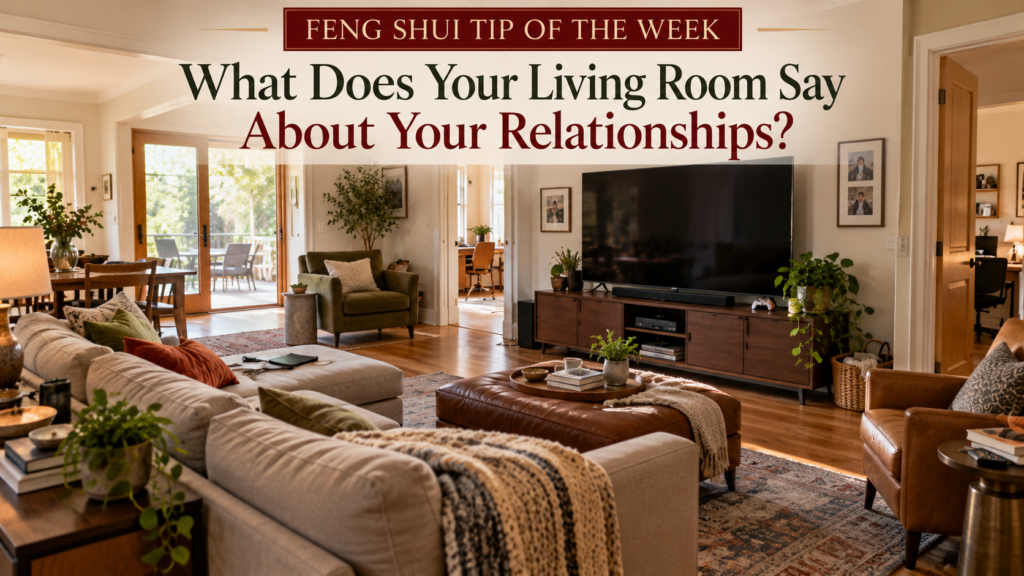
Take a look at your own living room and notice how the seating is arranged.
Does it invite conversation?
Does it allow people to feel connected?
Or does everyone end up facing in the same direction?
I once worked with a client who was a very successful and attractive woman. She had created a wonderful life for herself, but she was frustrated that she couldn’t seem to find a man.
When I visited her home, I noticed something very interesting.
Her living room contained two large grey leather chairs — both facing directly forward toward a large television.
That was it!
So I asked her: if you did meet a man you really liked, how exactly would the two of you relate to each other in this room?
We both had to laugh.
Ideally, a living room should have enough seating to comfortably welcome several people — at least four proper seats if the room allows it.
I also like to see at least one sofa, so there is an opportunity for two people to sit more closely together. At the same time, a couple of individual chairs are helpful because many people appreciate having their own space.
Distance matters too.
If the seats are spread too far apart, the room can automatically feel disconnected. Ideally, each seat should have another seat nearby — usually within about five or six feet — so conversation feels natural rather than something you have to work at.
The seating should also feel as though it gathers around a common centre.
You want the energy to collect rather than scatter.
And this is where many modern living rooms run into another problem: the television.
Because watching television and films has become such a central part of home life, the entire room can easily end up being organised around the screen rather than around the people.
And that can subtly change the energy of the space.
So this week, have a look at your living room and ask yourself:
Does this room really encourage people to connect with one another?
Happy relating!
– E. J. Shaffert
PS: If you would like to learn more about Feng Shui and how you can use it to improve your home and your life – click the “Home Page” link at the top and at the bottom of that page, we have information about our next online Taster Workshop.
These online workshops are a fun way to explore Feng Shui and learn some principles you an apply right away!